

Searching for 540n? The code may help you locate a product listing, but the characters alone do not tell you what the item is or whether it meets your needs. Before buying, look for the full product name and identifier, the manufacturer, and documentation that connects those details.
A practical way to assess a listing is to separate what its source states from what you would have to assume. Check that the model code matches exactly, then compare the listed product details with the information in the supporting document. This guide explains what to record, how to handle inconsistencies, and how to avoid treating a partial code as a complete specification.
These checks are useful for bathroom products as well as other purchases. When comparing bathroom fixtures, apply them to the product identity and the specific requirements that matter for your space. A code is a starting point for research, not a substitute for clear product information.
Key Takeaways
- Start with the original source where 540N appears, then find the full product identifier and manufacturer.
- Check that the identifier, manufacturer, and document describe the same product before comparing specifications.
- Treat 540n as a search clue, not proof of a specific product or variant.
- Compare only details explicitly stated in the sources, and record missing or conflicting information.
- Make a purchase decision when the product identity and the requirements that matter to you are supported by clear documentation.
What Does 540N Identify? Start by Establishing the Product Context
The code 540N, by itself, does not give you enough information to identify a product, variant, or application. Start by treating it as a search term. Look for a source that links the code to a named product and manufacturer before you rely on any details in a listing.
A product identifier is not a complete product specification. To establish what a code refers to, look for supporting evidence: the manufacturer’s name, the full model designation, and documentation that connects them. Without that context, you cannot reliably tell what the item is or whether its specifications suit your requirements.
Why the 540N code needs context
Short codes can be ambiguous. A listing may show only part of a longer model designation, or omit characters that distinguish one item from another. This does not show that 540N refers to multiple products; it means the code alone is not enough to establish which product a particular source describes.
Copy the identifier exactly as it appears, including letters, spaces, punctuation, and any prefix or suffix. Then compare that copy with the code in the product document. Do not silently remove characters or treat a similar-looking designation as an exact match. For example, if one source shows “540N” and another includes additional characters, record both versions and look for a source that explains their relationship.
Which source details help identify a product?
Begin with the manufacturer’s product document or an official product listing. Check whether it gives the same complete code and names the manufacturer. Read the document title and product description too, because a code on its own may appear without enough surrounding information to identify the item. If a source describes an application, rely on the source’s explicit wording rather than guessing from the code.
Keep source-backed facts separate from open questions. A simple evidence table makes that easier:
| Item to check | Verified from source | Unresolved or assumed |
|---|---|---|
| Exact code | Copy it as printed | Any missing or mismatched characters |
| Manufacturer | Record the named manufacturer | Identity inferred from the code alone |
| Document | Note its title and source | Details not supported by that document |
Use the unresolved column actively. If the product name, identifier, or manufacturer does not line up across the sources, do not move straight to comparing specifications. First identify which item each source describes. For background only, you can read about hydraulic systems, but that reference does not identify 540N or establish that the code relates to hydraulics.
Once the source establishes a product identity, make a separate list of the specifications that matter to your decision. For a bathroom fixture, that may include product type, dimensions, material, or compatibility, but only when the source states those details. The code itself does not supply them.
How to Verify a 540N Listing Against Reliable Product Documentation
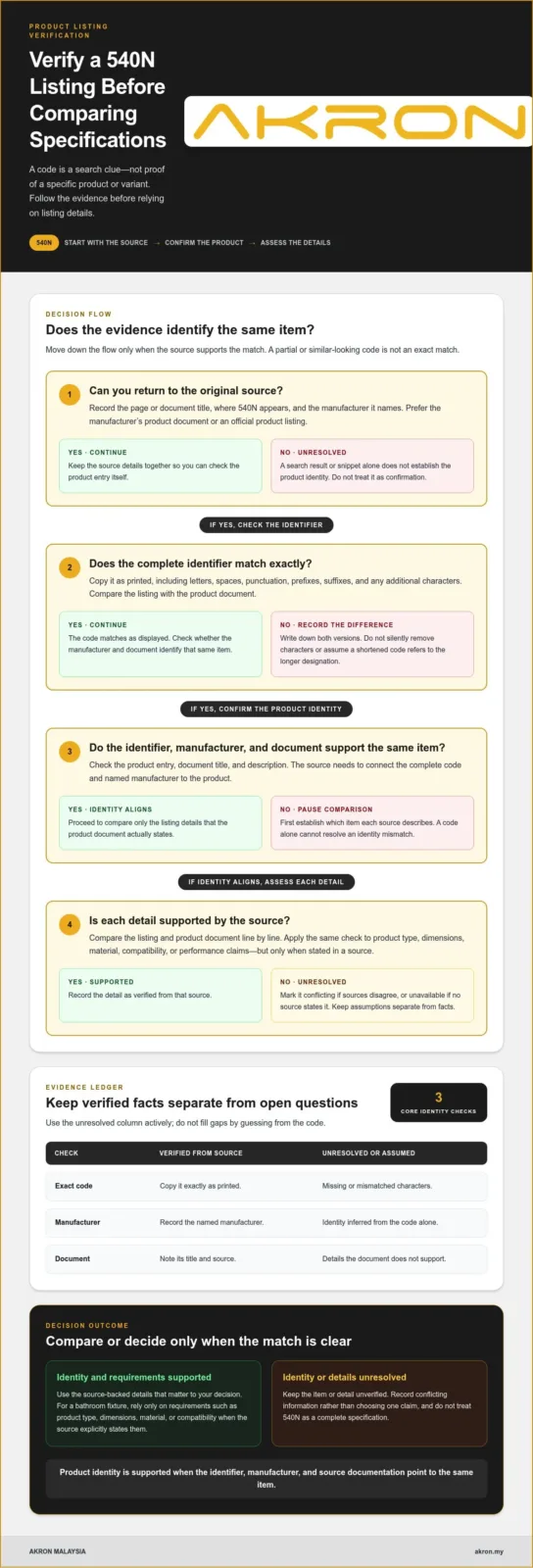
Use a source-first process before comparing product details. Search results can help you find a relevant document, but a short snippet may leave out part of a model code or the context around it. Open the underlying page or document and check that its product entry supports the claim made in the listing.
A source-first check for the 540N identifier
Start with the page or document where you found the code. Record its title, the manufacturer it names, and the complete identifier as displayed. Then find the product entry in the document and check whether it connects those details to the same item. Keeping them together makes it easier to catch a mismatch between a search result and the source itself.
Follow this workflow:
- 1. Preserve the original source. Note its title and where the code appeared. Keep a copy of the relevant page or document details so you can return to the same information.
- 2. Find the complete identifier. Check the product entry for any prefix, suffix, or additional characters that a search result may have left out.
- 3. Match the manufacturer and document. Confirm that the named manufacturer and the document’s product entry refer to the same item.
- 4. Compare only after identity aligns. Check the listing’s details against the product document. Do not use the code alone to fill in specifications the source does not state.
A product match is credible only when the identifier, manufacturer, and source documentation support the same item. A reference to a standards organization, such as SAE International, does not by itself establish a product’s identity or specifications. The documentation needs to link the standard or claim to the particular item.
How to handle conflicting or incomplete details
Compare the listing with the product document line by line. Mark each detail you need as supported, conflicting, or unavailable. For example, if a listing gives a shortened code but the document shows a longer model designation, record the difference. Do not assume they match unless a source explains the relationship.
Apply the same approach to dimensions, materials, compatibility, and performance claims. If a source does not state a measurement or application, leave it unresolved. If two sources give different details, record both and note where each appears instead of choosing the more appealing claim.
A search snippet is a lead, not a substitute for the underlying documentation. When information is incomplete, use the source to identify what is missing. That helps you focus your next search on the full model code or the specific product detail you need, rather than repeatedly searching the same short identifier.
How to Compare 540N Results Without Guessing at Specifications
Once you have several possible listings, compare the evidence rather than relying on similar wording. Keep every entry tied to its own source and exact code. A structured comparison helps show what the documents establish, where they differ, and which points remain unanswered.
A practical comparison table for product listings
Use one row for each source. Enter only details that the source explicitly states, and write “Not stated” when it leaves a field blank. That means the source has not established the detail; it does not prove that the product lacks it. If two sources disagree, keep both statements visible and identify their sources.
| Exact code | Manufacturer | Document source | Stated details | Unresolved questions |
|---|---|---|---|---|
| Copy as printed | As named in source | Document or listing title | Only source-backed details | Missing or unclear information |
| Copy as printed | As named in source | Document or listing title | Only source-backed details | Conflicts or unanswered points |
Compare like with like. If one source gives a full model designation and another shows only 540n, keep their details separate unless a document connects the two codes. Do not decide that one listing is the better match merely because its description sounds similar. The product identity needs to align first.
If a source cites a technical standard, read the referenced document only to understand the claim being made. For example, SAE J517 Hydraulic Hose Standard is context for a source that actually refers to it. The reference alone does not identify 540N or prove that the standard applies to a listing you are considering.
Red flags in an ambiguous product listing
Pause when a listing omits the manufacturer, shortens the model code, or gives specifications without identifying their source. Also be cautious when photographs, descriptions, or model numbers are similar but the documents do not establish that they refer to the same product. These are reasons to seek clearer product information, not reasons to complete the missing details yourself.
When comparing bathroom fixtures, begin with the product category and requirements for your space. Check each relevant detail against the product information instead of assuming that a code tells you the fixture’s size, material, or compatibility. For a clear view of Akron Malaysia’s bathroom products, browse the bathroom product range and compare the listed products with your requirements.
540N Purchase Checklist: Make a Decision Only After the Match Is Clear
Before acting on a listing, separate what its documentation verifies from what remains unanswered. A short code can help you find a product record, but it cannot replace one. Use this final check to judge whether you have enough reliable information to make your decision.
A final check before acting on a 540N listing
- Verified identity: The source shows the complete identifier and the manufacturer’s name together with the relevant product entry.
- Verified details: The specifications that matter to your decision are explicitly stated and clearly tied to that product.
- Unresolved details: Missing, conflicting, or unclear information is recorded as unknown, not filled in by inference.
- Decision readiness: The documented product identity and relevant requirements align with what you need.
Verify the complete code and its source before treating a listing as a match. If the documentation does not establish the product identity, do not rely on similar wording, a partial code, or an unsupported claim. Apply the same rule when a decision-critical detail is missing: make your choice based on documented information, not an assumption.
This process gives you a clear record of what you know and what remains open. It also makes comparisons more useful: you can see which products have documented details that meet your requirements and which listings still lack the evidence you need.
When bathroom planning is also on your list
If you are planning a bathroom update, explore the bathroom product range for bathroom essentials. Compare each product’s listed details with the needs of your space, and treat that product research separately from identifying what 540N refers to.
Make Your Next Purchase With Confidence
A short code like 540n is a starting point, not a complete buying specification. Match the full identifier with the manufacturer and product documentation, then compare only the details the sources actually state. Keep missing or conflicting information visible instead of turning it into an assumption.
If the product identity or a detail that matters to your decision remains unclear, base your next step on the source information you still need. A careful comparison helps you distinguish a confirmed match from a listing that only looks similar.
Planning a bathroom update? Explore Akron Malaysia’s bathroom product range and compare its water closets and other bathroom fixtures with your requirements. Browse the range to take the next step in planning your space.
Frequently Asked Questions
What does 540N mean?
The code alone does not explain what 540N means or identify a particular product. It could be a model reference, part of a longer designation, or another type of identifier. Do not assume which interpretation is correct without a product source that connects the complete code to a named item. Look for the manufacturer’s name and a document that explicitly links them.
Is 540N a complete product model number?
The code by itself does not show whether 540N is a complete model number. Some product designations include additional letters or numbers, and a shortened version may leave out details that distinguish one item from another. Compare the code exactly as shown in a listing with the designation in the product document. If the source uses a longer code, look for documentation that explains how the two versions relate before treating them as a match.
How can I verify a product listed as 540N?
Start with the page or document where you found 540N. Record its title, the manufacturer it names, and the complete code shown in the product entry. Check whether the source connects that identifier to a particular product, then compare the listing details with the product documentation. Mark each detail as supported, conflicting, or unavailable. Search snippets can help locate a source, but the underlying page or document is needed for a careful comparison.
Can two products use the same 540N identifier?
The code alone does not establish whether separate products use the same 540N identifier. Do not assume that matching short codes prove two listings describe the same item, or that they prove the items are different. Compare each listing’s full designation, manufacturer, and source documentation. If the sources do not establish a clear match, keep the records separate rather than combining their details.
What should I check before buying a product marked 540N?
Confirm that the complete code and manufacturer match the product entry in the source document. Then check that the specifications important to your decision are explicitly stated and linked to that product. Record details that are missing or conflicting instead of filling them in from a similar listing or the code itself. A purchase comparison is more dependable when both the product identity and the relevant requirements are supported by the available documentation.
Why do search results for 540N show different kinds of pages?
Search results can include different kinds of pages because a short code may appear in different contexts, and search engines can return pages based on matching text. Some results may be product listings or documents, while others may mention the code without explaining it. Appearing in the same results does not prove that pages describe the same item. Open each source and check whether it identifies the manufacturer and the full product designation.